Reconstructing the Past – Functional and Comparative Morphological Research
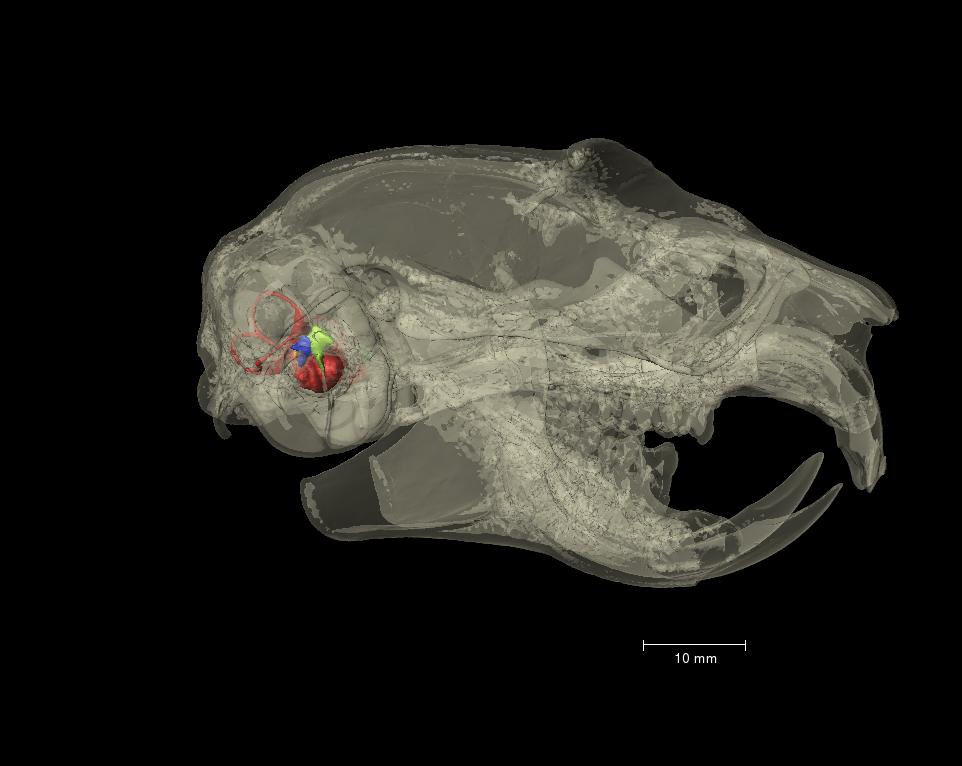
Topic: Bony labyrinth and middle ear region of mammals
My research focuses on the linkage between the anatomy of the bony labyrinth and the corresponding locomotion mode by comparative investigations of extant and extinct taxa of vertzberates. As the sense of balance, the anatomy of the semicircular canals of the inner ear represents an anatomical signal corresponding to the locomotion mode of the specimen. The inner ear itself is composed of three semicircular canals housed in the petrosal bone of the skull, which enables investigations of extinct taxa.
For resolving phylogenetic issues, I am additionally focussing on the morphology of the auditory ossicles and the bony septa of the middle ear cavity. To enhance comparability, I designed the ‚septal compass’, as a graphical representation of the internal anatomy of the ear region, but also the ‚septal formula’ for the numeric acquisition. This phylogenetic approach will be continued in other groups of rodents.
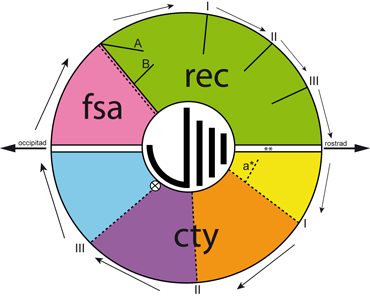
septal compass
Topic: Musculotendinous system of fishes
This topic is focussing on the functional-morphological adaptations of the musculotendinous system in extinct and extant actinopterygians and Chondrichthyes. The morphology and ecology of fishes are extremely diverse. Depending on the habitat, fishes have different locomotion modes caused by different types of musculotendinous systems. Depending on the habitat and the phylogenetic position of the investigated species, the locomotory system consists of red and white muscles, which are separated by myosepta and bony tendons. For comparative studies, techniques of ‚clearing and staining’, histological serial sections and non-invasive micro-CT scanning combined with staining methods are used. Furthermore, I want to link the anatomy of the musculotendinous system to the anatomy of the semicircular canals in actinopterygians, to reconstruct the paleoecology of selected families.